We summarize IPAC processing of data from the Infra-Red Telescope in Space to obtain spacecraft pointing information using STS, the J-band Star Sensor. The data solved include all but a few orbits from those (180-283) included in the north-scan ("pre-flip") period, and all orbits (346-586) from the south-scan, or "post-flip" period. Pointing uncertainties based on STS for the south-scan data were ~40" in-scan and < 1' cross-scan. For the north-scan data, taken at low |b| where source confusion and background variation were complicating factors, uncertainties are typically significantly less than 1' in-scan and 2' cross-scan, respectively.
| I. | Introduction |
| II. | Processing Overview |
| III. | Source Extraction |
| IV. | Position Reconstruction |
| V. | Quality Checks |
| VI. | Special Situations and Caveats |
| Appendix 1: | Glossary & Notation |
| Appendix 2: | Summary File Format |
| Appendix 3: | Tgood Orbit Event File |
| Appendix 4: | IPAC Boresight File Format |
| Table 3: | Summary File Segment Fit Listing |
| Table 4: | Tgood.ver5 Orbit File Event Listing |
| Figures: | Figure Captions |
Reconstructions have been completed for all orbits in the pre-flip packets (179-283, 105 orbits total), except for the first orbit (179) and orbit 272. For the post-flip data, which were generally less problematic because of reduced source confusion, essentially all orbits (of 241 total) have been reconstructed, and all but a very few are quite satisfactory. Over 90% of the 105 pre-flip orbits passed a set of strict quality standards, detailed in Section IV; significant parts of about nine orbits could not be reconstructed to pass these criteria. An even higher fraction of post-flip orbits passed. Orbits failing the criteria in Section IV have been flagged with pointing uncertainties of 99' in the results.
(Dr. Minoru Freund when he was at IPAC used NIRS data to successfully solve the 42 orbits, from 305-346, when the STS was turned off; and solved as well a key portion of orbit 180. This NIRS analysis has been described in a separate document, and is not treated here.)
In addition to describing the meaning and limitations of the information directly present in the boresight, or output files, this document includes some background material on IRTS and on IPAC internal files and programs, in order to provide a self-contained reference against future need. As a consequence, it contains a mixture of information important for external users, as well as a compilation of reference information mostly of interest within IPAC.
Pre-Flip

 Packet        Orbits
03292312:     179 - 196
03310335:     197 - 209
03312358:     210 - 226
04020237:     227 - 240
04030028:     241 - 255
04031330:     256 - 271
04050109:     272 - 283

Post-Flip (STS on)

04092249:     346 - 363
04110242:     364 - 378
04120140:     378 - 393
04130040:     393 - 409
04140046:     409 - 425
04150222:     425 - 438
04152348:     438 - 454
04170049:     454 - 470
04180057:     470 - 485
04190035:     485 - 500
04200009:     500 - 516
04210105:     516 - 531
04220036:     531 - 546
04230012:     546 - 561
04232351:     561 - 576
04250016:     576 - 586
The ISAS InfraRed Telescope in Space ("IRTS", Nakagawa 1995), was a 15 cm, f/4 Ritchey-Chretien design, the focal plane of which was cooled to 1.9 K. The spacecraft, Space Flyer Unit, (SFU, Murakami et al. 1996) was launched into a 486 km, 28.5 degree orbit on 1995-03-18 (Figure 1). Scientific data were collected from 1995-03-29 at 23:48:40 UTC through 1995-04-25 11:34:19 UTC, after the 90 liters of liquid He cryogen were exhausted. The telescope looked out radially, nearly perpendicular to the spin axis of the SFU. The spin axis was approximately aligned towards the Sun. In order to avoid looking at the Earth, IRTS maintained a spinrate of approximately one revolution per orbit. A description of the four scientific instruments (cf Appendix 1) on IRTS and their scientific objectives has been given by Murakami et al. 1996. Figure 2 shows the geometry of the IRTS focal plane, and Table 2 gives its nominal dimensions, based on laboratory theodolite measurements made at 300 K. Note especially that the co-ordinate axes in Table 2 have been chosen to agree with those in Figure 2; but that in every other place in this document the co-ordinate definitions differ so that x and y are interchanged, making x the cross-scan co-ordinate, and y in-scan. For the post-flip data this interchange of x and y is all that is needed. However, since the in-scan co-ordinate always increases with time, its sense is reversed from that shown in Figure 2, for pre-flip only.
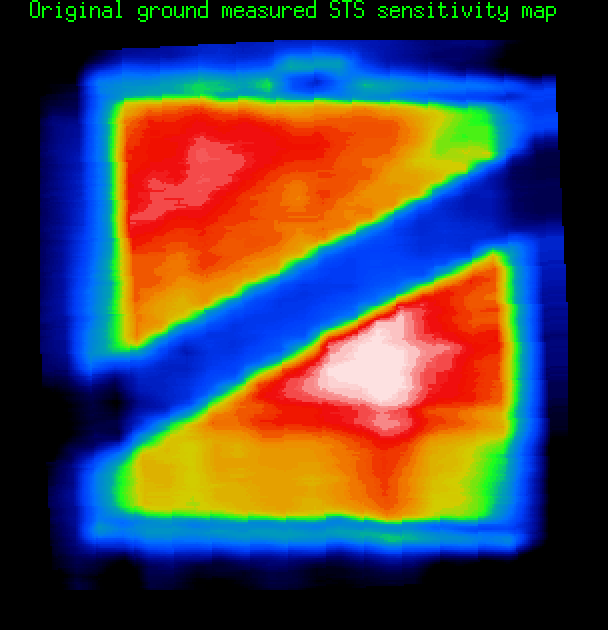
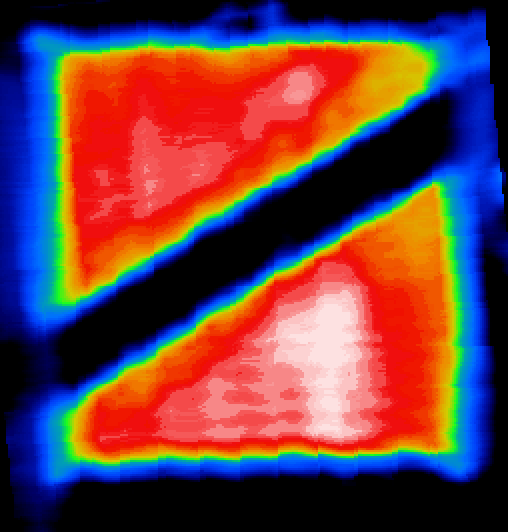
In addition to the four main scientific instruments, the IRTS payload included a J-band (1.25 micron) Ge photodiode Star Sensor (Murakami et al. 1994), the STS, capable of sensing stars as faint as 6 mag in unconfused regions of the sky, and yielding positions with an accuracy of the order of 1 min of arc, depending on the brightness of the star and the spatial structure of the background. STS data, with augmentation by NIRS in special situations, were the basis for the position reconstructions obtained at IPAC. The STS had an approximately square field-of-view (FOV), nominally 18 X 18 arcmin in size, centered 1 degree below the center ("boresight") of the IRTS focal plane (Figure 2). A diagonally obscuring stripe resulted in a 2-lobed response, with the position of the dip between lobes giving the cross-scan (x) co-ordinate with RMS accuracy typically about 1.5'. In-scan (y) positions were typically measured with an accuracy of ~0.4'. Figure 3 ( a, b) shows maps of the STS response.
Pt.       STS            FILM           MIRS          NIRS
C1  (-10.84,-63.0)  ( 1.50, 51.0)  (-55.16,-2.0)  (60.50,-1.0)
C2  (  6.50,-63.0)  ( 1.84, 72.0)  (-55.16, 5.0)  (60.50, 6.0)
C3  (  6.50,-46.0)  (-6.17, 72.0)  (-63.17, 5.0)  (52.16, 6.0)
C4  (-10.84,-45.0)  (-6.50, 51.0)  (-63.17,-2.0)  (52.16,-1.0)
Nominal focal plane geometry adopted by IPAC in arc min. Cf. Figure 2. (Note the co-ordinate interchange between x and y, as discussed in the text.)
A glossary of special terms appears in the Appendix.
In this document we have adopted the convention that
computer programs and filenames
(eg, manfit) appear in computer type style,
whereas normal mathematical
symbols and multi-character program variables names
(eg, dsy) appear in italics.
Figure 1 shows the IRTS orbit geometry with key events and segment boundaries indicated. Times in the boresight ("IPAC att_lan") files appear as "IRTS-time" (or "launch time"), seconds since launch on 1995-03-18 at 08:01:00 UTC, to be distinguished from "IPAC-time", seconds since 1995-03-15 at 00:00:00 UTC. Thus for the times given in seconds, IPAC-time = IRTS-time + 288,060 s. In general, times in IPAC files and programs other than the boresight files are in IPAC time. The beginning of the orbit is denoted "Point D", and occurs 90 degrees in mean anomaly after the mid-point of orbit day. The "A" segment of the orbit extends from Point D until orbit sunset. The "B" segment, which is identical with orbit night, follows. The final, or "C" segment extends from sunrise until the succeeding Point D. Other portions of orbits have been labeled with a 2-letter code, for the beginning and ending segment. The designations "AB" and "CC" are particularly common and important, the former including A+B, the latter all of the C segment. These have normally been used as reconstruction fit intervals.
Appendix 2 and
Table 3 summarize the solutions obtained
for each segment, as described in the summary files.
Here and elsewhere,
all celestial positions are given for epoch and equinox B1950.
Appendix 3 and
Table 4 give details of the modified orbit event,
or "Tgood" files, which contain comprehensive information
about a variety of on-orbit events and conditions.
It became apparent early in the analysis that the pre-flip data would be considerably more difficult to interpret than the post-flip data due to the greatly increased source confusion problems associated with the low inclination to the galactic plane of the pre-flip scans. Thus the post-flip data were in general processed earlier, and the pre-flip data later, so that the pre-flip could benefit from the improved techniques and lessons learned on the post-flip. Thus the discussion must often distinguish between pre-flip and post-flip, as the analysis methods, fitting, and quality criteria were sometimes different.
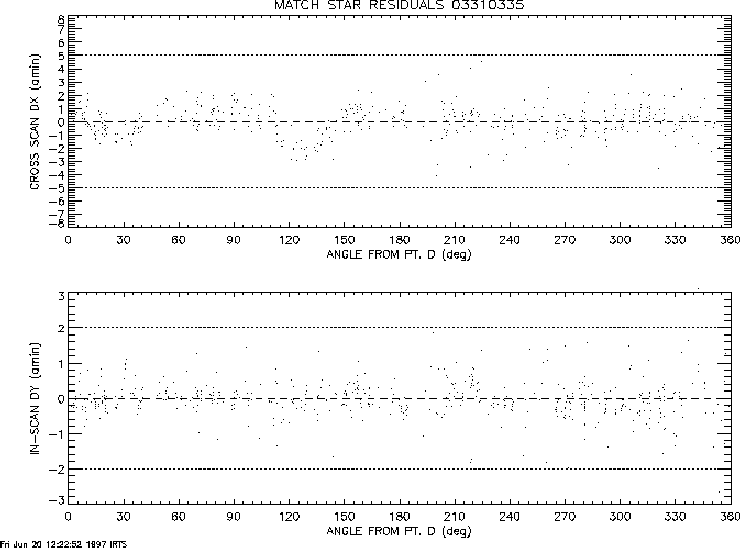
The total number of match stars for the 103 reconstructed pre-flip orbits is ~6000, for an average of ~58 stars per orbit. The most detailed information about the accuracy of the solutions obtained can be found in the time-series plots of residuals and histograms of residuals. In this section we present plots of pre-flip in-scan and cross-scan residuals against angular distance from Point D, and histograms of the same, for the seven pre-flip packets altogether and for each packet individually. Since the distributions are for single STS star observations, the least-square aspect solution should normally be considerably better than the RMS width of the histograms, depending on the number of stars fit in the segment. On the other hand there are situations, as for example one can see by the cross-scan ripple (cfSection VI.D. below) where the residuals are clearly not normally distributed, and the error may be larger. Figure 4a shows in-scan and cross-scan residuals versus scan angle from Point D, for all the astrometric match stars in the seven pre-flip packets. Figure 4b shows the corresponding residuals' histograms.
Figure 5a shows in-scan and cross-scan residuals versus scan angle from Point D, for all the astrometric match stars in packet 03292312, including orbits 180-196. Figure 5b shows the corresponding residuals' histograms.
Figure 6a shows in-scan and cross-scan residuals versus scan angle from Point D, for all the astrometric match stars in packet 03310335, including orbits 197-209. Figure 6b shows the corresponding residuals' histograms.
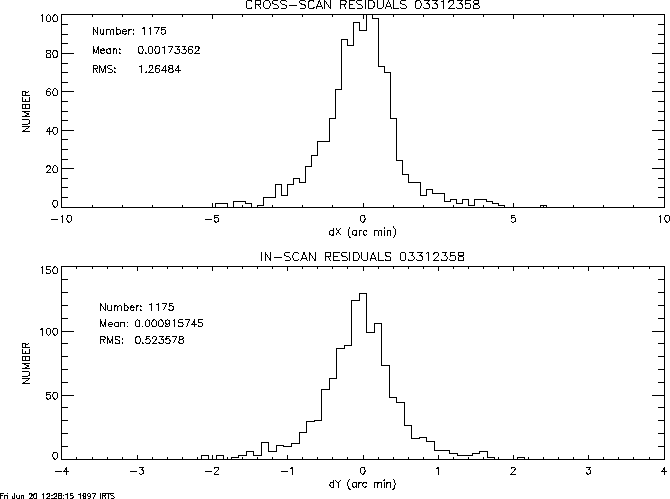
Figure 7a shows in-scan and cross-scan residuals versus scan angle from Point D, for all the astrometric match stars in packet 03312358, including orbits 210-226. Figure 7b shows the corresponding residuals' histograms.
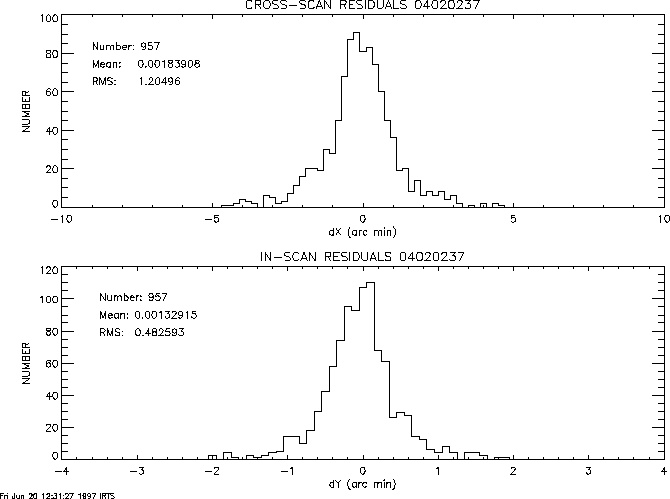
Figure 8a shows in-scan and cross-scan residuals versus scan angle from Point D, for all the astrometric match stars in packet 04020237, including orbits 227-240. Figure 8b shows the corresponding residuals' histograms.
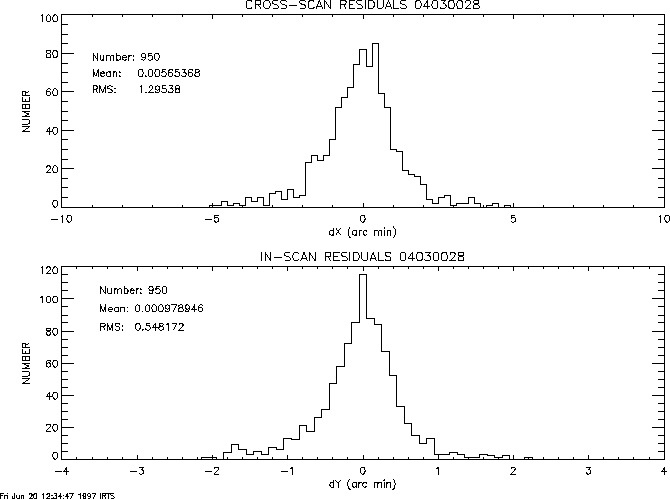
Figure 9a shows in-scan and cross-scan residuals versus scan angle from Point D, for all the astrometric match stars in packet 04030028, including orbits 241-255. Figure 9b shows the corresponding residuals' histograms.
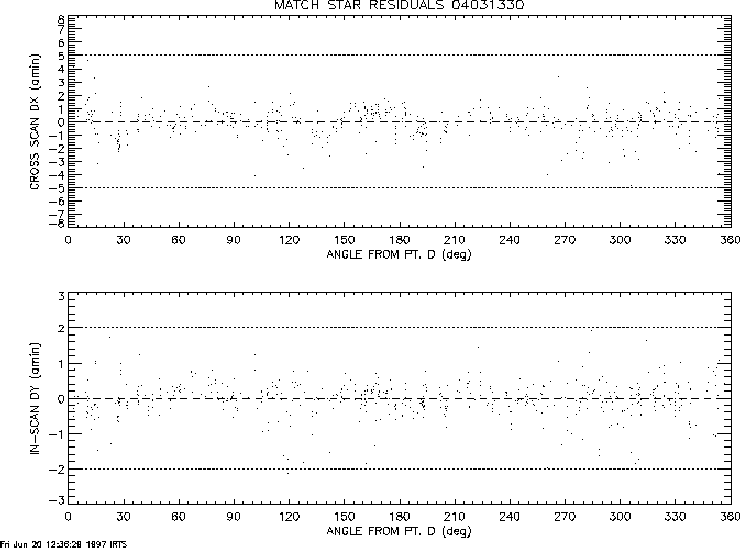
Figure 10a shows in-scan and cross-scan residuals versus scan angle from Point D, for all the astrometric match stars in packet 04031330, including orbits 256-271. Figure 10b shows the corresponding residuals' histograms.
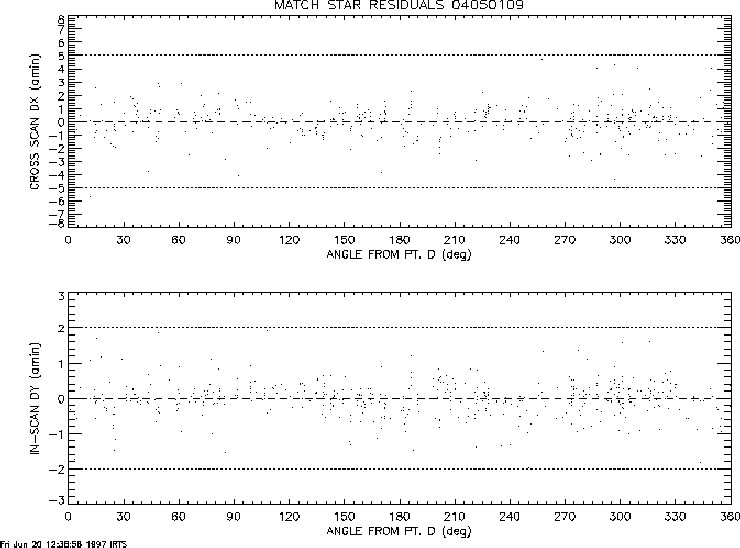
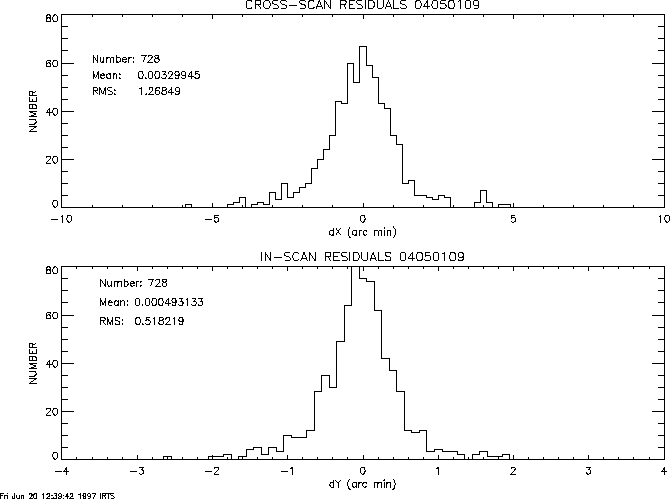
Figure 11a shows in-scan and cross-scan residuals versus scan angle from Point D, for all the astrometric match stars in packet 04050109, including orbits 273-283. Figure 11b shows the corresponding residuals' histograms.
The first was the creation of a J-band astrometric star catalog, (JCAT), by B. Smith of IPAC. The IRAS Faint Source Survey (Moshir et al. 1992), the associated FSS Optical Identification database (Conrow et al. 1994) and the PPM Positions and Proper Motions catalog (Bastian & Röser 1991) were used to generate a catalog with astrometric positions and predicted J-band magnitudes, with approximately half a million entries, going down to J~10 mag. The sources included stars known either optically or from IRAS, or both. For stars with no IRAS counterpart, the J magnitudes were extrapolated from V magnitudes using their spectral types along with an extinction model (Jarrett 1992). The V magnitudes were not homogeneous, but depended on the optical catalog from which they were taken. JCAT contains ~73,000 stars with J < 6.5 and ~517,000 stars for J < 10. The predicted J magnitudes have been found to agree to within ~1.4 mag for sources observed by 2MASS and CIO.
Next was the extraction of candidate astrometric stars from the STS data.
This step is described in Section III below.
The reconstruction itself, described in Section IV below,
was an iterative process.
Once a good solution was obtained for each orbit, the program makebph
created the corresponding boresight file.
After concatenation into packets, various quality checks have been performed,
as described in Section V.
att_lan" files with IRTS times for each frame,
orbital information and coarse aspect, estimated a priori.
All files received were converted into ASCII, generally
standard table files.
For standard table files,
header rows at the beginning of the file define the contents, width,
and type of the information in each column, so that they
are largely self-documenting.
| Input STS binary TLM data files: |
sout_ppppppppcc-xxxo11
|
Input att_lan:
|
eatt_ppppppppcc-xxxo11
|
| Input orbit event data: |
Tgood.ver4
|
Here pppppppp is packet,
and xxx is orbit number.
Input STS binary TLM data files were converted to
give an ASCII sequence of (time, voltage) pairs for the STS;
input att_lan files were converted to
table files with times converted from IRTS time to IPAC time,
and the orbit-event information was converted to Tgood.ver4.
The IPAC output, or boresight, files are ASCII table files, with one row for each ~1 second of data, and contain the sky co-ordinates of the boresight, STS (C2 point) and other information, all supplied in fixed-width columns. Appendix 4 describes the format in further detail.
| Program: | Input Data: | Output Data: | Function: |
|---|---|---|---|
pointless | sout_*
| ssrc_* | Extract sources |
manfit
(or: autmch, )
| ssrc_* | ||
makebph
| summary |
output_xxxSS*
| Write boresight file |
cmpoutext |
manmch or extcat
| cmpoutext.xxx
| Check internal consistency |
cmpoutnirs | NIRS.cat
| cmpoutnirs.xxx
| Check NIRS consistency |
cmpoutmirs | MIRS.cat
| cmpoutmirs.xxx
| Check MIRS consistency |
The detection step involves the use of a matched filter. In this step, the time sequence of data samples for each scan of the star sensor was passed through a linear filter whose output was in the form of a 2-dimensional image. This filter had a better performance than a zero sum filter since the background was independently removed from the data. The matched filter output was detected with a threshold set at a specified level (typically 4-sigmas, corresponding to m(J) < 6.5 approximately) and a list of candidate sources produced. For each candidate detection, the most probable 2-d position and magnitude were estimated, together with the associated reduced chi squared. Finally, source verification was performed. In order to determine whether an extracted source was genuine, two tests were performed: (a) chi-squared test, and (b) a check on qualitative morphological structure of the extracted profile (specifically, that it should possess precisely two broad peaks).
Figure 3a shows the original STS response map (PSF), as measured prior to launch. To improve the ability of the algorithm to discriminate against spurious detections, the original STS response map was refined using the observed profiles of bright sources. Approximately 500 sources of magnitude 4.5 or brighter, detected during the post-flip scans of April 21-24, 1995, were employed for this purpose. Comparing the expected profile from the original PSF with the actual data, we adjusted the original PSF. Typical adjustments were of the order of 10% of the peak response.
In addition, the distribution of in-scan position offsets with respect to known stars showed a trend with respect to the cross-scan position of the reference star. This indicated that the star sensor scanned the sky at angle of ~2.7 deg around the +Z_I axis of the instrument. Comparison with a very limited amount of MIRS ( cf Section V.D) data indicated that at that time the satellite itself scanned along the y-axis of the focal plane as planned. The 2.7 deg angle was therefore treated as if it were due to a rotation of the STS relative to the focal plane, and a rotation was applied to the STS response function. The validity of the refined response map was verified by performing a further iteration, whereby the residuals were found to be gaussian, and of the order of 1% of the peak. The refined, rotated map appears in Figure 3b.
In the post-flip scans, approximately 50,000 STS point source detections
were obtained at S/N > 5.
These point source detections resulted in
sightings of over 28,000 JCAT sources.
During the shorter duration pre-flip period,
over 20,000 STS detections were obtained at a S/N > 5; these
resulted in sightings of over 3,600 JCAT sources.
The list of extracted stars is placed in the
ssrc_* file for the orbit.
In general, an initial solution was used to give approximate positions for all the extracted stars. Extracted stars could then be looked up in JCAT, and if good candidates were found, they were added to the list of identified sources, and used to determine an improved solution. However, starting the process was sometimes difficult, especially for the pre-flip orbits.
For the post-flip scans, where source confusion was not an impediment, the following method was developed:
eatt_* file for the orbit),
and increasing the size of the swath to allow for the uncertainties,
select from JCAT a list of astrometric sources which could potentially
be identified with sources in the extracted source list.
The least-squares fit is described further in Section IV.B. below.
The pre-flip scans were done in an analogous manner except that due to increased confusion and extinction close to the galactic plane, the extraction / reference matching step described above was more difficult for the pre-flip scans.
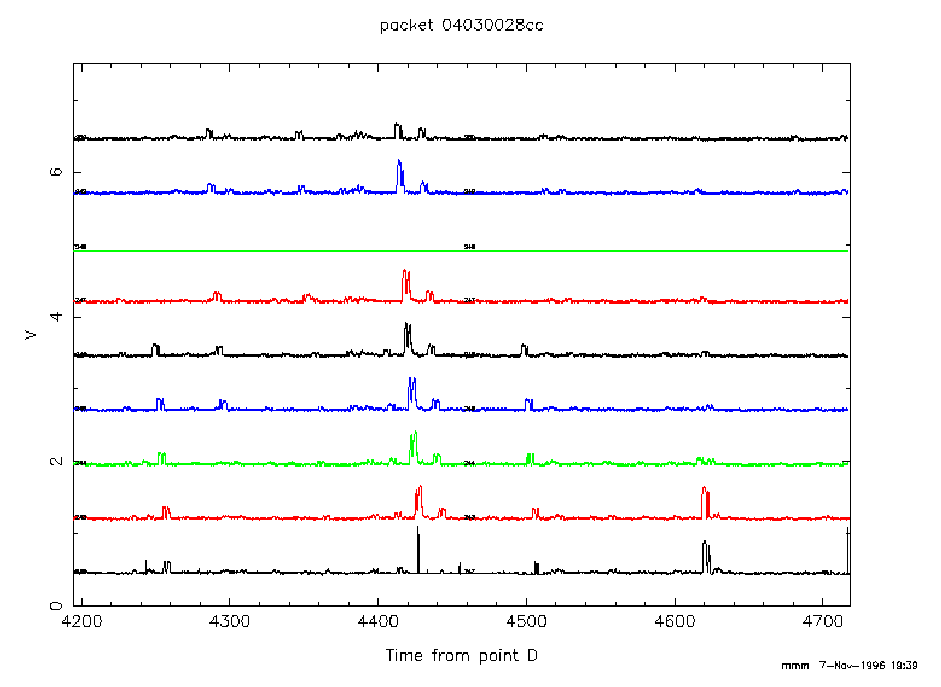
A very powerful technique, once a few orbits have been solved, is to look for stars repeating in adjacent orbits, at least one of which has been solved. Figure 12 shows a portion of a series of well-behaved pre-flip orbits with several obvious "repeaters". This method can be misleading when applied to fainter stars, because of the large number of possible candidates, but it has been found to be the most generally useful method for starting the solution for most orbits when the method described for the post-flip analysis fails.
For about half of the orbits in the pre-flip period, the following series of semi-automatic steps, based on repeating sources, was successful:
manfit, a minimum of three
good stars were needed to start the solution.
Once a good preliminary solution was found,
identifications could be made in JCAT for many fainter extract stars.
To fit astrometric candidate stars to a model for the scan, we first
read from an input file manmch,
a list of candidate assignments
between extracted stars (each specified by
the integer part of the
IPAC time), and positions for each (normally found by searching JCAT
for tentative identifications).
The program manfit then finds the
best least-squares solution to fit the given candidates.
manfit model for a segment of IRTS
data is uniform rotation about the nominal
spin axis fixed on the sky,
(and fixed in the body axes of the SFU),
with the boresight fixed (90 degrees + epsilon ) from the spin
pole, where epsilon is a small angle.
Parameters determined from the data by manfit include
the celestial coordinates of the spin axis,
the spin rate omega (defined in terms of dsy, the fractional
deviation from the nominal value omega0 given
in the Tgood file,
as described in Appendix 2),
the phase angle of the boresight at the beginning t0 of the orbit,
and
the parameter epsilon.
RMS in-scan and cross-scan residuals, sigy and sigx,
as minimized by the fit,
also appear in the fit output or summary file,
along with RMS difference sigm
between the STS-observed J-magnitudes of
the extract stars and the J-magnitudes expected from their tentative
JCAT identifications.
manmch
stars was close positional agreement.
For almost all of these orbits
the rule-of-thumb was 2' in-scan and 5' cross-scan.
An important secondary criterion was magnitude agreement,
although (due to the uncertainties involved in generating JCAT magnitudes)
we found that the presence of a candidate with a measured IRAS 12 micron
flux was more important that magnitude agreement itself.
In a few cases, good candidates which would ordinarily have been acceptable could not be distinguished from others which were equally probable. If both candidates were very close together the choice would not affect the final solution very much. However, in some cases the ambiguous stars were not close to each other, and in such situations the decision was generally taken that it was better to reject both, rather than risk an incorrect assignment's degrading the results.
In the iterative process of fitting to pre-flip data,
after each manfit iteration,
residuals were checked for satisfactory agreement.
For flexibility, manfit has
provision for assigning each of the astrometric candidate stars in
the manmch file a weight.
For the pre-flip processing described here,
this facility was used only to permit
manmch files to be set up to completely
ignore groups of stars by setting their weights to zero.
This allowed the same list of stars to be used for both
AB and CC segments of an orbit,
by setting the weights to 0 or 1, which was a convenience.
Unacceptable match stars were removed by setting their
manmch weights to zero (but usually left in the file,
to show that they had been considered).
Then a search of JCAT was performed to see if an alternate
acceptable match candidate could be located.
manmch
astrometric stars than some processed earlier.
Most of the orbits processed later have 50-90 match stars, with
at least 20 in each fit segment.
An attempt was made to find matches for all the brighter
extract stars in each segment;
4th magnitude was the rule-of-thumb threshold,
though not uniformly applied in the orbits analyzed earlier.
If no brighter extract stars could be matched,
fainter candidates were tried, until
any large (eg, > 500 s, ~35 degrees) gaps in coverage were filled.
Failure to find any reasonable candidate for
several bright extracted stars
was taken as a sign that the solution is not reliable,
and is reflected
in the value for Flag1 in the Tgood.ver5
file and the corresponding
uncertainties assigned in the final boresight files.
manfit model described previously.
summary file (Table 3),
but for a few the solution parameters are identical for AB and CC.
This indicates that those orbits were actually fit as one segment, rather
than two.
Figure 13 and Figure 14
compare the solutions
before and after the B-C boundary for one of the first pre-flip orbits
processed manually which was found to require segmentation.
For each figure all the manmch stars listed for the orbit
are plotted, but those excluded from the fit (ie, with 0 weight)
have been boxed.
The amplitude of the characteristic sinusoidal
cross-scan residual indicates the
approximate value of the spin pole motion is 12',
and may be compared with the value of ~0.2 degrees from
the summary file.
Input to manfit includes the manmch file,
the list of extract stars for the orbit
in the ssrc_* file, and the Tgood.ver4 file.
The output of manfit includes a
list of output parameters for the new
best-fit solution, saved as one line in the summary file,
plus fit residuals (manres file) for each
manmch star,
and an estimate, according to the solution, of the celestial position of
each extract star in the orbit (mancat).
Finally, the manres file was used to generate time histories and
histograms of the residuals in x and y, such as those
in Figure 24.
For the final, most troublesome group of pre-flip orbits,
manfit was used exclusively, but more automated versions
(autmch and multch) were generally used
to implement the iterative processes
described in Sections IV.A.1. and IV.A.2., especially for the post-flip data.
Given the final summary files,
the program makebph (cf Section II.D.)
then generated the boresight file for the orbit.
Because of the occasional need to interpolate across gaps,
this step was generally performed
only after all the orbits for a complete packet had been solved.
Besides the summary file with the fit input
from manfit,
makebph uses the Tgood
files (both ver 4 and ver 5),
and the eatt_* file with the time stamps.
It writes a piece of the boresight file (named output_xxxSS.ver2,
where xxx is orbit number and SS fit segment, either AB or CC)
for each fit segment that it finds in the
summary file for the orbit.
The segments were finally concatenated together into a single
combined_att_lan.* for the packet.
The overall fit quality obtained is evident from the RMS residual plots in Figures 4-11, and the information concerning acceptable orbits and segments in Section III. Because of the policy of normally accepting astrometric stars for which a reasonable candidate could be found within 2' in-scan and 5' cross-scan, there remains a slight danger that a spurious solution could be obtained. However, the typical RMS agreement was normally so much less than the rejection criteria (the latter being 3-4 sigma) that this danger is believed to be small. A very few orbits or segments have in-scan and cross-scan residuals so much more than the normal (< 0.5' and < 1.5', respectively) that there is doubt. Orbit 273 is an example, one of the worst. These have been flagged with large uncertainties.
As a general overall check on each packet, we have run so-called
"postage-stamp" plots,
which are of the difference between the original
ISAS a priori estimate of the
aspect and the final IPAC solution from the
combined_att_lan.* file,
both in-scan and cross-scan.
Since the final and original solutions are
sometimes very different, these plots
are not reliable indicators of problems, but may call attention to
errors and provide some reassurance that the processing
has been well-behaved for most orbits.
The program cmpoutext checks for any inconsistencies
between the boresight file and the orbital fit,
comparing the STS position from the boresight file
with the manmch positions for the input match stars.
It generates in-scan and cross-scan difference
histograms for each orbit.
These are generally similar to the manres
histograms of residuals,
and to the RMS fit errors sigx and sigy
reported for each segment in the summary file.
We have verified the external consistency of our reconstructions using MIRS
and NIRS data, kindly provided by Drs. Freund and Yamamura on behalf of the
MIRS and NIRS teams, respectively.
We have converted the MIRS and NIRS
detection times into positions using our reconstructions,
and then found the most likely JCAT matches for those sightings.
Using a galactic latitude |b| < 5 degress criterion,
we produced a list limited to the most unambiguous sightings.
For NIRS, a test for reasonalbe color was used as well.
Then cmpoutnirs and cmpoutmirs compared
the JCAT match positions to the STS-reconstructed positions a the
times of the NIRS / MIRS detections.
This procedure measured the focal plane offsets
of these detections with respect to
point C2 of the STS, to provide a check on the
boresight solution and the nominal focal plane geometry.
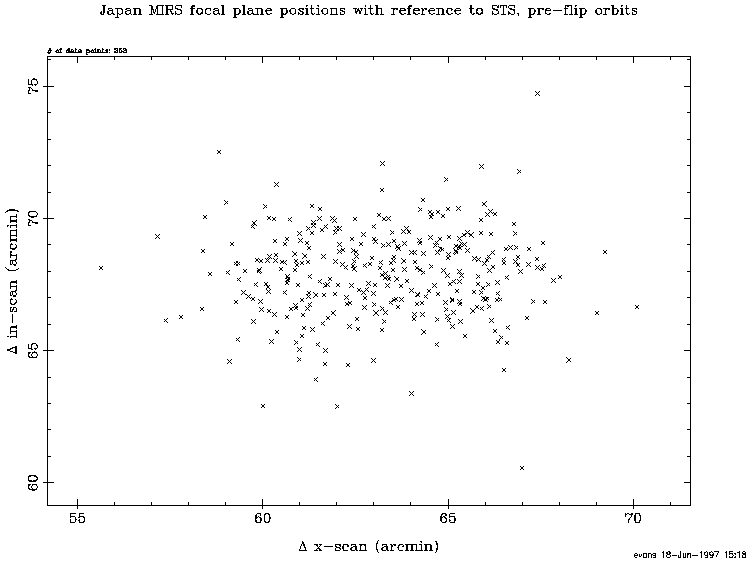
For example, Figure 15 shows focal plane positions of sources detected by MIRS, for the pre-flip period. (We thank Prof. Onaka for providing these pre-flip MIRS detections and associations.) Using the STS boresight solution, an approximate celestial position was determined for each MIRS detection. Each source was then identified using JCAT, and the resulting true celestial positions compared with the reconstructed STS positions. Sources with |b| < 5 degrees were removed from the detection list, to reduce the effect of false identifications; 353 sources survived this editing process. If the boresight solution were perfect, the identifications were all good, and the focal plane geometry exactly as determined from the pre-launch 300K calibrations, the result would be a cluster of stars filling the nominal 8' X 8' MIRS field-of-view, at the nominal position (Figure 2).
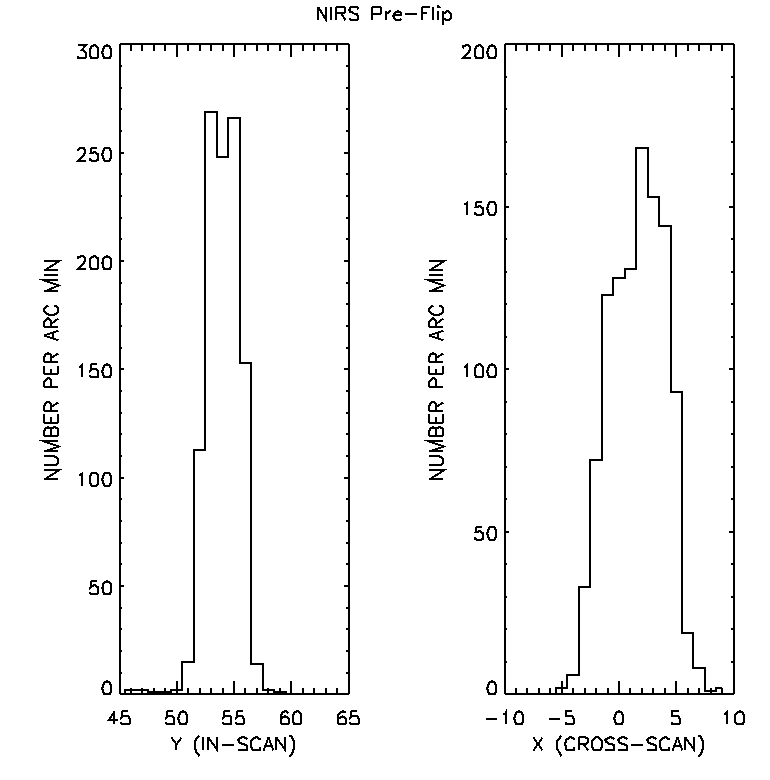
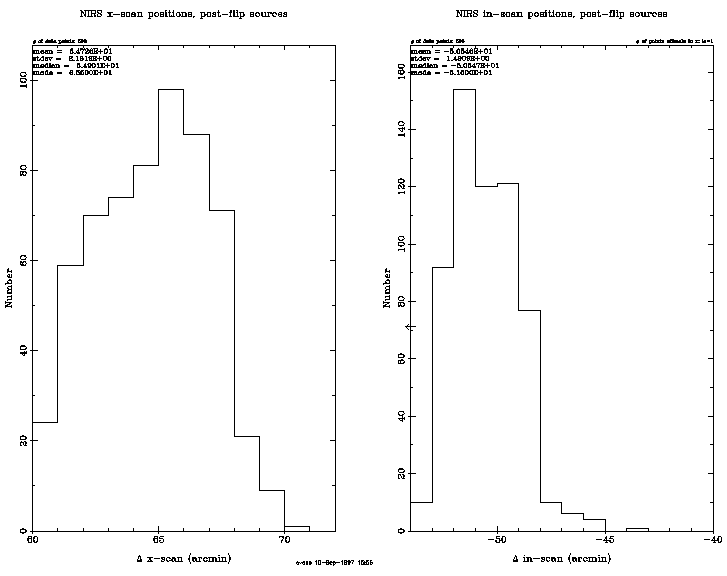
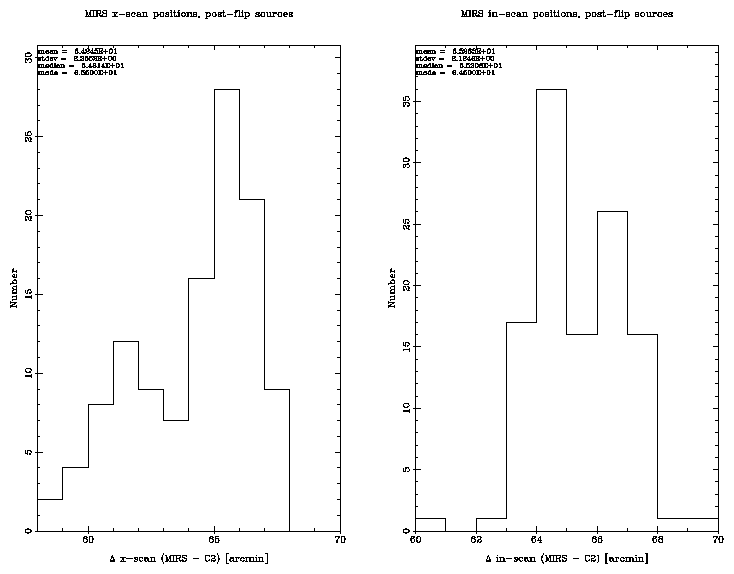
Figure 16 shows in-scan and cross-scan histograms of the data in Figure 15. Figure 17 and Figure 18 show similar scatter plots and histograms for 1090 NIRS-detected sources in the pre-flip period. For NIRS, in addition to the |b| < 5 filtering, sources were removed based on a J-12 micron color test to further reduce the effects of false identifications. For the post-flip data, Figure 19 and Figure 20 show corresponding plots for 596 NIRS sources, and Figure 21 and Figure 22 for MIRS, respectively,
These figures show that the offsets differ by ~2' from the nominal measurements.
For the pre-flip data, both MIRS and NIRS detections offsets have been examined extensively. The offsets have shown consistent small discrepancies from the nominal focal plane measurements provided by the instrument teams. Currently, these discrepancies in the in- and cross-scan directions are 2.6' and 1.65' for MIRS, and 2.28' and ~0' for NIRS. Thus, our suggested measurements of the center of the MIRS and NIRS detectors (in units of minutes of arc) from the pre-flip data are as follows:
SUGGESTED center of MIRS       NOMINAL center of MIRS
IN-SCAN      CROSS-SCAN   vs.  IN-SCAN         CROSS-SCAN
 -60.94          0.             -58.34             1.65

SUGGESTED center of NIRS       NOMINAL center of NIRS
IN-SCAN      CROSS-SCAN   vs.  IN-SCAN         CROSS-SCAN
  54.05          2.5             56.33             2.5
The exact causes of these small deviations from nominal measurements in the STS, MIRS and NIRS statistics may be related to several possibilities, such as: 1) a slanted scan pattern, 2) a physical rotation of the STS, 3) electronic timing delays, 4) possible beam pattern asymmetries in NIRS and MIRS.
For the post-flip data, a small set of MIRS detections were used to verify external consistency. This data set, however, is too small to independently establish the center measurements for the detector or to distinguish between the possible causes for the deviations listed above. We are have analyzed a somewhat larger set of NIRS data, and the results strongly suggest that a slanted scan pattern is present, as indicated in Figure 23. A larger number of NIRS and MIRS detections will be needed to complete this analysis at ISAS.
During the course of the work a number of special situations and conditions arose, of which the user should be aware. We describe these here.
Frequently no or very few good match stars could be found in the AA segment, from Point D to the end of orbit day. This situation is apparently related to the change of aspect at Point D, and a corresponding wobble or nutation associated with it. Also, in many orbits, the scan rate changes during this 500 sec interval. As a result, the uncertainties in the boresight files have been systematically increased during the first 500 seconds of the AA segment to account for this circumstance.
In a number of orbits significant spin-axis changes
occurred during the middle of a
a fit segment.
Examples were orbits 194, 209, 216, and 224, among others.
Some of these were known a priori from the Tgood file,
and some were discovered during analysis.
In either case no credible match stars can be found beyond the change, and the
fit must be broken off.
Data in the region with no good fit has been interpolated, and flagged with
Flag1 = 5 in the Tgood file,
and uncertainty 99' in the boresight file.
A change in IRU MODE from "High" to "Low" occurred 1995-03-30 at 02:26:13, during the CC segment of orbit 180. A change in IRU MODE from "Low" to "High" occurred 1995-04-04 at 23:30:13, during the CC segment of orbit 270. Partly as a result, substantial portions of both of these orbits could not be solved. A few other orbits (eg, 201) were affected by gyro problems for short periods, which have been flagged.
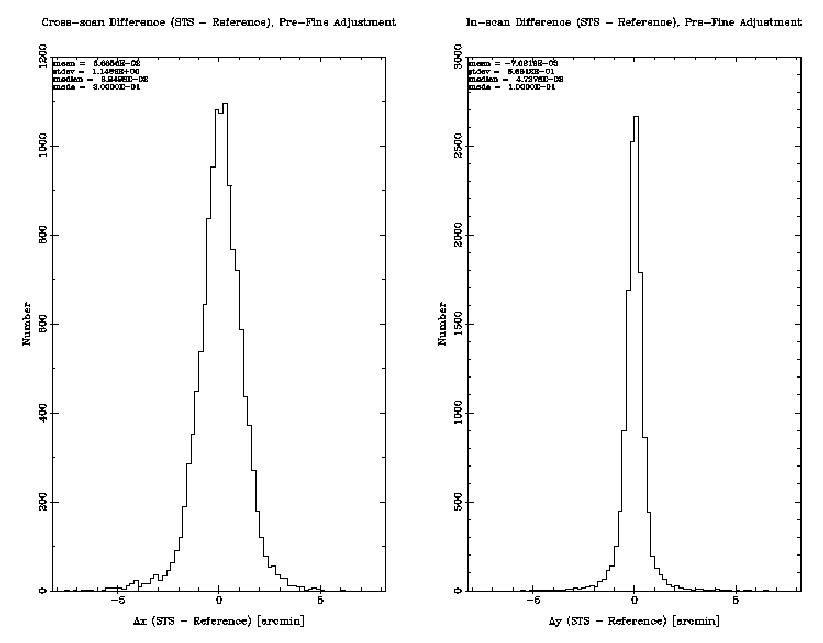
Almost all orbits displayed a characteristic cross-scan ripple, of amplitude up to 2', at certain points in the day / night cycle. In particular, the reconstruction residuals from eclipse exit back to Point-D show a time variation akin to a limit cycle (Cf Figure 24a for post-flip, and Figure 4a for pre-flip). For post-flip, this oscillation had a peak to peak range of about 4' in the cross-scan direction, and a much smaller range in the in-scan direction. For the post-flip data only, we have removed this periodic trend. Figure 24b shows post-flip residuals after removal of the ripple. Figure 25a and Figure 25b show the corresponding residual histograms. As a result, our internal reconstruction uncertainties have been reduced to 40" and 1' in the in-scan and cross-scan directions, respectively. The effect is smaller (< 1') and less consistent in the pre-flip data, and entangled with the other problems which afflict the pre-flip period. For this reason we have not attempted to apply a similar correction to the pre-flip solutions.
The cause of this variation (with a period of approximately 1500 seconds) is not known in detail. As in the AA segment, most of the effect can be attributed to small adjustments by the aspect control system, as eg, at orbit dawn, when the sun-sensor would often make a small correction.
For the pre-flip data, no good solution has been obtained for the following orbits: 182, 185-187, and 271-272. Orbits 180-181, 270, and 273 have significant intervals when the solution is absent or degraded, and have been flagged. All post-flip orbits have been solved.
Finally, we stress again that it is essential for the user to check the uncertainty information in the boresight file when using these data. Otherwise inaccurate aspect information is liable to be used.
We thank Dr. Minoru Freund, of NASA Ames and ISAS, for many helpful comments and other contributions to the STS work during his NIRS analysis at IPAC. This work was carried out at the Infrared Processing and Analysis Center, with funding from NASA under contract to the California Institute of Technology and the Jet Propulsion Laboratory.
Bastian & Röser 1991 Sterne und Weltraum, 30: 592.
Conrow et al. 1993 BAAS 183:03.03.
Jarrett, T. 1992 Ph.D. Thesis, University of Massachusetts.
Moshir, M. et al. 1992 Explanatory Supplement to the IRSA
Faint Source Survey, Version 2, JPL D-10015 8/92 (Pasadena: JPL).
Murakami, Hiroshi et al. 1994
Ap.J 428: 354.
Murakami, Hiroshi et al. 1996
Proc. Astron. Soc. Jap. 48: L41-46.
Nakagawa, 1995
The header lines for this ASCII table file show the variable names,
variable types, and units for each column.
The first header line of an ASCII table file gives a list of variable names for
each column, separated by "|"'s, indicating the field width.
The second header line gives the type of the data, such as char
or ch for character,
int or i for integer, and real for floating point.
Each row is the result of a segment fit by
Columns 10-11 give
epsilon (defined in the text, shown as
Column 12 gives dsy,
the fitted fractional deviation from the nominal spinrate omega0,
from the
The final columns in the summary file give the RMS
width of the x (cross-scan)
and y (in-scan) fit residuals, of the magnitude agreement,
and the year, day-of-year, and time of
Table 3 summarizes the
solutions obtained for each segment.
The
The modified orbit event,
or "
Table 4 gives a listing of the
"
Column 1 gives the packet number.
Column 2 gives the orbit number.
Column 3 gives the segment designation letter (A, B, or C).
Column 4 gives the subsegmentation as a 2-digit code "nm",
where n is subsegment number
out of a total of m subsegments in the segment.
For example, "12" means first subsegment out of two.
The most common case, "11", means no subsegmentation was required.
Subsegmentation typically either occurred because of an a priori known
unusual
orbit event (eg, thruster use or aspect control
mode change), or the occurrence of a region where no solution could be
obtained, as determined after processing.
Column 5 gives segment start time.
Column 6 gives the time interval for gyro rates to settle (sec)
after the segment start time.
Column 7 gives segment stop time.
Column 8 gives the time interval of bad gyro behavior at the
end of a segment (sec).
(This occurs when a gyro event starts slightly before an orbital event.)
Column 9 gives omega0, the nominal spinrate, in arcmin per second..
Column 10 gives the uncertainty on omega0.
Column 11 gives an array of 14 flags, describing various aspects of the data.
The first of these, Flag1, is particularly important,
describing the overall reliability of the solution obtained.
The final columns translate the segment start time
into normal calendar date and time.
The
Digit of "flags" parameter = Flag number:
The STS and boresight history files described above, have the following
format:
Figure 2: IRTS Focal Plane Geometry
The focal plane geometry adopted by IPAC
(from Table 2) for position
reconstruction.
Measurements in degrees.
Figure 3: STS Response Map.
Figure 3a:
The original point spread function (PSF) for the STS, determined
by pre-launch calibration.
Figure 3b:
The final STS response map, refined from the original based on sightings of
approximately 500 stars brighter than 4.5 magnitude,
and rotated by 2.7 degrees, as described in the text.
Figure 4: Pre-Flip Residuals, All Packets.
Figure 4a: History of residuals versus
angular distance (~time) from
the initial point D of the orbit, for all pre-flip orbits, 180-283.
Figure 4b: Histograms of
the distribution of the residuals in Figure 4a.
Figure 5: Residuals for Packet 03292312, Orbits 180-196.
Figure 5a: History of residuals versus
angular distance from the initial point D of the orbit, for orbits 180-196.
Figure 5b: Histograms of
the distribution of the residuals in Figure 5a.
Figure 6: Residuals for Packet 03310335, Orbits 197-209.
Figure 6a: History of residuals versus
angular distance from the initial point D of the orbit, for orbits 197-209.
Figure 6b: Histograms of
the distribution of the residuals in Figure 6a.
Figure 7: Residuals for Packet 03312358, Orbits 210-226.
Figure 7a: History of residuals versus
angular distance from the initial point D of the orbit, for orbits 210-226.
Figure 7b: Histograms of
the distribution of the residuals in Figure 7a.
Figure 8: Residuals for Packet 04020237, Orbits 227-240.
Figure 8a: History of residuals versus
angular distance from the initial point D of the orbit, for orbits 227-240.
Figure 8b: Histograms of
the distribution of the residuals in Figure 8a.
Figure 9: Residuals for Packet 04030028, Orbits 241-255.
Figure 9a: History of residuals versus
angular distance from the initial point D of the orbit, for orbits 241-255.
Figure 9b: Histograms of
the distribution of the residuals in Figure 9a.
Figure 10: Residuals for Packet 04031330, Orbits 256-271.
Figure 10a: History of residuals versus
angular distance from the initial point D of the orbit, for orbits 256-271.
Figure 10b: Histograms of
the distribution of the residuals in Figure 10a.
Figure 11: Residuals for Packet 04050109, Orbits 273-283.
Figure 11a: History of residuals versus
angular distance from the initial point D of the orbit, for orbits 273-283.
Figure 11b: Histograms of
the distribution of the residuals in Figure 11a.
Figure 12: Typical Pre-flip Data Showing Repeaters.
A ~500 sec segment of STS data from orbits 242 (bottom) - 250 (top),
showing repeated appearances of some dozen strong to moderate sources.
From such information it was usually possible to find an initial
set of match stars for starting an unsolved orbit, based on comparison with
a previously solved orbit adjacent to it.
Figure 13: Orbit 256 Fit Before Segment BC Boundary.
The sources shown are all extracted stars, but only those between the sunset
and sunrise (unboxed) have been used in the fit.
The large discontinuity in the cross-scan residuals at sunrise is due
to a motion of the spin pole.
Figure 14: Orbit 256 Fit After Segment BC Boundary.
Same as Figure 13, except only extract sources after the B-C boundary
have been used in the fit.
As can be seen from the amplitude of the segment B cross-scan residuals,
the best-fit poles between the AB and CC segment fits differ by about 12'.
For this orbit, only about 1500 sec of data
from the CC segment were available.
Figure 15: MIRS Source Focal Plane Positions
for Pre-Flip.
Focal plane positions of 353 sources detected by MIRS,
for the pre-flip period.
The distribution of points reflects the MIRS FOV, while the position
checks the co-ordinates in the focal plane.
See text.
Figure 16: Histogram of MIRS Source Focal
Plane Positions for Pre-Flip.
The data from Figure 15 are histogramed in x (cross-scan) and
y (in-scan).
Figure 17: NIRS Source Focal Plane Positions
for Pre-Flip.
Analysis similar to that for Figure 15 above, as detailed in the text.
Figure 18: Histogram of NIRS Source Focal
Plane Positions for Pre-Flip.
The data from Figure 17 are histogramed versus y (in-scan) and
x (cross-scan).
Figure 19: NIRS Source Focal Plane Positions
for Post-Flip.
Analysis similar to that for Figure 15 above, as detailed in the text.
In-scan position is with respect to STS C2.
Figure 20: Histogram of NIRS Source Focal
Plane Positions for Post-Flip.
The data from Figure 19 are histogramed in x (cross-scan) and
y (in-scan).
Figure 21: MIRS Source Focal Plane Positions
for Post-Flip.
Focal plane positions of
sources detected by MIRS,
for the post-flip period.
Analysis similar to Figure 15 above, as detailed in the text.
Figure 22: Histogram of MIRS Source Focal
Plane Positions for Post-Flip.
The data from Figure 21 are histogramed in x (cross-scan) and
y (in-scan).
Figure 23: NIRS Detections
with respect to NIRS Center.
The in-scan (y) positions for post-flip sources versus orbit number
for the post-flip period.
The NIRS source detections were processed similarly to those shown in
Figure 19 above, but are based on an earlier version of the solution.
The in-scan positions are with respect to the NIRS center.
Significant variations with time, especially from about orbit 480 to 550,
are evident.
Figure 24: Post-Flip Residuals Before (a) and After (b) Removal of Ripple.
Figure 24a
shows the cross-scan (upper panel) and in-scan (lower) residuals
initially obtained for the post-flip data.
Figure 24b shows the residuals after correction
for ripple, as described in the text.
Figure 25: Histograms of Post-Flip Residuals Before (a) and After (b) Removal of Ripple.
Figure 25a
shows histograms of the cross-scan (left panel) and in-scan (right panel) residuals
initially obtained for the post-flip data.
Figure 25b shows histograms of the residuals after correction.
APPENDIX 1: Glossary and Notation
Glossary:
Term:           Definition:

AB              Segment of orbit from Point D to orbit sunrise.
boresight       Nominal center of IRTS FOV, co-ordinate (0,0)in
                  focal plane
C2              Physical corner of STS, adopted as reference point;
                cf Figure 2 & Table 2
CC              Segment of orbit from orbit sunrise to following
                  Point D.
FILM            Far-IR Line Mapper, instrument on IRTS
FIRP            Far-IR Photometer, instrument on IRTS
g-angle         Sun-to-spin axis angle.
IPAC            Infrared Processing and Analysis Center, Caltech
IPAC-time       Time in seconds since 1995-03-15 at 00:00:00 UTC.
IRAS            InfraRed Astronomical Satellite.
IRTS            InfraRed Telescope in Space
IRTS-time       Time in seconds since launch, at 1995-03-18,
                  08:01:00 UTC.
ISAS            Institute of Space and Astronautical Science
JCAT            J-band IR star catalog constructed at IPAC for IRTS
                  STS data analysis.
MIRS            Mid-IR Spectrometer,  instrument on IRTS
NIRS            Near-IR Spectrometer, instrument on IRTS
Point D         Initial point of orbit, defined to be 90 degrees
                  past orbit noon.
Post-flip       "South-Scan Data", second part of IRTS mission.
PPM             Positions and Proper Motions Catalog of Optical Sources.
Pre-flip        "North-Scan Data", first part of IRTS mission.
PSF             Point Spread Function, = STS response function.
repeater        Stars seen in STS on adjacent orbits.
RMS             Root-mean-square.
SFU             Space Flyer Unit
STS             STar Sensor, J-band diagonal mask type on IRTS.
Notation:
Orbits are defined to begin at point D, and extend to point D
of the following orbit, approximately 5650 seconds.
Segment A extends from point D to the immediately following orbit sunset,
about 510 seconds.
Segment B is orbit night, or eclipse, and extends from sunset to orbit dawn,
about 2150 sec.
Thus the AB segment, including A and B, has a duration somewhat less than
2800 seconds.
The CC segment, from orbit dawn until the following point D, has a duration
of nearly 3000 sec.
Appendix 2: Fit Segment Summary Information
Format of Summary File for Pre-Flip
Header:
|packet  |orb|sg|t0        |tf        |alfp    |delp    |alf0    |del0    |eps  |dy0  |dsy      |mchf|mchp|nfit|sigx|sigy|sigm|datime0  |dt |comment|
|int     |int|ch|double    |double    |real    |real    |real    |real    |real |real |real     |int |int |int |real|real|real|int      |i  |char   |
|mmddhhmm|-- |--|sec       |sec       |deg     |deg     |deg     |deg     |amin |amin |--       |--  |--  |--  |amin|amin|mag |yydoyhhmm|min|--     |
manfit
(cf Section IV in the text).
Columns 1-5 give packet number, orbit, and fit segment designation, and start
and stop IPAC times.
Columns 6-9 give the RA and Dec of the spin pole, and the
RA and Dec of the normal to the spin axis,
in the plane of the boresight,
at the beginning t0 of the orbit.
Here and elsewhere, all celestial positions are
given for epoch and equinox B1950.
eps in the header),
and dy0, the phase offset at t0.
For the earlier analysis only, especially the post-flip,
the phase was defined so that dy0 was the fitted
parameter, and typically non-zero.
For the later analysis, especially the pre-flip, dy0
was defined to be zero, and the phase variation was taken up
in the Ra and Dec of the spin-axis normal vector;
thus dy0 is always 0 for these later data.
Tgood file,
described in Appendix 3.
The nominal omega0 was determined from gyro data.
The final fitted spinrate omega
for the segment is then given by:
manfit processing.
summary
files, pre-flip.summary and post-flip.summary
are critical to the analysis, and have been placed under Sun
Source Code Control System (SCCS) configuration control,
in the /irtsdev/sccs/ directory.
Appendix 3: Tgood Orbit Event File
Tgood.ver5 Format Summary
Tgood.ver5" file,
has, in addition to the nominal orbit
event and segment information,
has the sub-segmentation information for the A, B,
and C segments which was
found necessary for some orbits due to situations
discovered during the analysis,
and quality information resulting from the fits, encoded
in Flag1 (see below).
Another version of Tgood, Version 4, is used by
manfit and makebph, and is generally similar
except that it lacks the sub-segmentation of the A, B,
and C segments, the quality information in Flag1,
and also lacks the Moon flag, Flag9.
(Thus it has one less flag, and flags beyond 9
are shifted accordingly.)
Tgood.ver5" file,
Tgood (both versions 4 and 5)
files, named Tgood.ver4 and Tgood.ver5,
are critical to the analysis, and have been placed under Sun
Source Code Control System (SCCS) configuration control,
in the /irtsdev/sccs/ directory.
Header:
The first header line gives a list of variable names for
each column, separated by "|"'s, indicating the field width.
The second header line gives the type of the data, such as char for character,
int or i for integer, and real for floating point.
(Despite the header reproduced here, the header is not present in the
actual files; as they normally are for standard table files.
We reproduce the header lines here, and in the file listing,
for information purposes.)
|packet |orb|seg|cc|t0 |dt |tf | dt_end | phidot |sigpd |flags | UT |
| char |int|c |i | real | real | real | real | real | real | int | char |
FORTRAN Format:
format(a8,1x,i3,3x,a1,1x,2(i1),1x,f10.2,1x,f8.2,
+ 1x,f10.2,1x,f8.2,1x,
+ f10.7,1x,f9.7,1x,14(i1),1x,14(i1))
Definitions:
For variable names in the header.
format(i1,'/',i2,1x,i2,':',i2,':',i2).
Appendix 4: IPAC boresight File Format
The file header:
\ Reconstructed Attitude File (IPAC- Phase I)
\
|date-time |LAUNCHtime |ra_sts |dec_sts |sigi|sigx|posang |sigpa |FPang |sFPang |ra_bs |dec_bs |s1bs|s2bs|pa_bs |spa_bs |packet |qflag |spare |
|double |double |double |double |d |d |double |double |double |double |double |double |d |d |double |double |char |int |char |
|mmddhhmmss.sss|seconds |deg |deg |amin|amin|deg |deg |deg |deg |deg |deg |amin|amin|deg |deg | | | |
Format for reading the data:
integer*4 month, day, hour, minute
real*8 seconds
real*8 time, ra_sts, dec_sts, sigin_sts, sigx_sts, pa_sts,
real*8 sig_pa_sts, fp_ang, sig_fp_ang, ra_bs, dec_bs,
real*8 sigin_bs, sigx_bs, pa_bs
integer*4 numpacket, qflag(15)
character*6 spare
read("ipac_att_lan", 100) month, day, hour, minute, seconds,
time, ra_sts, dec_sts, sigin_sts, sigx_sts, pa_sts,
& sig_pa_sts, fp_ang, sig_fp_ang,
& ra_bs, dec_bs, sigin_bs, sigx_bs, pa_bs, sig_pa_bs, numpacket,
& qflag, spare
100 format(1x, 4i2, f6.3,
& f12.3, 2f9.4, 2f5.1, f9.4,
& f8.4, f9.4, f8.4,
& 2f9.4, 2f5.1, f9.4, f8.4, i8, 1x, 15i1, 1x, a6)
Definition of Variables:
-----------------------
date-time = month (mm), day(dd), hour(hh), minute(mm), second(ss.sss)
LAUNCHtime = time in seconds since launch (95-03-18 08:01:00 UT)
ra_sts = reconstructed right ascension (B1950) of STS lower right
corner as seen in Figure 7 of Murakami et al.
(1994, ApJ, 428, 354) This point is labeled "C2"
in the memo on the theodolite measurements of the
relative positions of the four corners of each FPI
dec_sts = reconstructed declination (B1950) of STS lower right corner
sigi = twice the standard deviation of the in-scan reconstruction (for
the star sensor data)
(for Nov. 1995 release, this is set equal
to 1' for all times except in the gyro settling periods
after an orbital event. In those intervals, this is set to 30')
sigx = twice the standard deviation of the cross-scan reconstruction (for
the star sensor data)
(for Nov. 1995 release, this is set equal
to 2' for all times except in the gyro settling periods
after an orbital event. In those intervals, this is set to 30')
posang = angle defining in-scan direction (east of north B1950).
(this is 90 deg off from the positional uncertainty
ellipse position angle for the star sensor data
if sigx > sigi, and equal to the error ellipse position
angle if sigi > sigx.)
sigpa = standard deviation of position angle for the star sensor position
(in Nov. 1995 release, this is not calculated, but is set to
zero)
FPang = the angle between the assumed in-scan direction according
to the nominal focal plane orientation and the actual
in scan direction
(in Phase 1, not reconstructed, but assumed equal to 0 deg)
sFPang = standard deviation of the FPangle
(not calculated in Phase 1; set equal to zero)
ra_bs = ra of boresight
(in Phase 1, calculated using FPang = 0 deg)
This is calculated using the theodolite measurements
of the distance between the nominal boresight to the STS
lower left corner. These measurements are 0.1083 degrees in
in-scan direction and -1.05 degrees in cross-scan direction.
dec_bs = dec of boresight
(in Phase 1, calculated using FPang = 0 deg)
This is calculated using the theodolite measurements
of the distance between the boresight to the STS
lower left corner.
sbsi = in-scan uncertainty of the boresight position
(in Phase 1, this is calculated using sigi, assuming an
additional systematic uncertainty of 1' due to the uncertainty
in the C2-boresight distance.)
sbsx = cross-scan uncertainty of the boresight position
(in Phase 1, this is calculated using sigi, assuming an
additional systematic uncertainty of 1' due to the uncertainty
in the C2-boresight distance.)
pa_bs = position angle of the boresight error ellipse
(east of north B1950)
(in Phase 1, this is set equal to posang)
spa_bs = standard deviation of the position angle for boresight uncertainty
ellipse
(in phase 1, assumed equal to sigpa)
packet = packet number of concatenated input ATT_LAN and IRTS_LAN files
qflag = quality flags
--------------------------
digits of quality flag parameter (1 corresponds to the leftmost digit):
1 = Did Not Match Flag => Did Not Match STS Stars in
this Time Interval
2 = Thruster Flag => Thruster Mode
3 = Bad/Missing Data Flag => Bad/Missing Data
4 = Bad Gyro Flag => Bad Behavior of Gyros
5 = Aperture Cover Flag => Aperture Cover On
6 = STS off Flag => Star Sensor Off
7 = G Angle Flag => G Angle Change
8 = Spin Rate Flag => Commanded Spin Rate Change
9 = Moon Flag => Moon Dominates Star Sensor
Data
10 = Split Packet Flag => Segment Split Between 2
Packets
11 = Low Latitude Flag => Low Latitude Scan (before
flip)
12 = Pt D to Eclipse In Flag => During Pt. D to Eclipse In
13 = Eclipse In to Eclipse Out Flag => During Eclipse In to Eclipse
Out
14 = Eclipse Out to Point D Flag => During Eclipse Out to Pt. D
15 = Could Not Fit Flag => Problem Fitting STS Stars in
this Time Interval
Table 3: Summary File Segment Fit Listing
Table 4: Tgood.ver5 Orbit Event File Listing
Figure Captions